Peneda-Gerês: Portugal's only national park
Most journeys through the Minho stop at Guimarães and Braga, and there is nothing wrong with that: a founding city and a cathedral town make a fine day. But keep driving north and east, past the last vineyards, into folded granite mountains that rise straight out of the Atlantic weather, and the country changes register entirely. This is Peneda-Gerês, Portugal’s only national park, and for travellers who have already met the country’s churches and coastlines, it is quietly the most unexpected place we send them.
A park older than its own borders
Peneda-Gerês was declared in 1971, the first and, to this day, the only national park in Portugal: roughly 700 square kilometres of mountain, oak forest and river valley strung along the Spanish border. People were living in these hills long before anyone drew a line around them. Neolithic stone tombs and Celtic hillforts still crown the ridgelines, and a stretch of Roman road, the Geira, cuts through the park almost exactly as it did when it carried soldiers and merchants between Braga and Astorga around 80 AD. Walk a surviving section, past its worn milestones, and the two thousand years in between feel oddly thin. In 2009, the park and its Spanish neighbour, the Baixa Limia-Serra do Xurés natural park, were joined into a single UNESCO Gerês-Xurés Transboundary Biosphere Reserve, a rare instance of two countries agreeing that a mountain range matters more than the border running through it.
Villages that still feed themselves
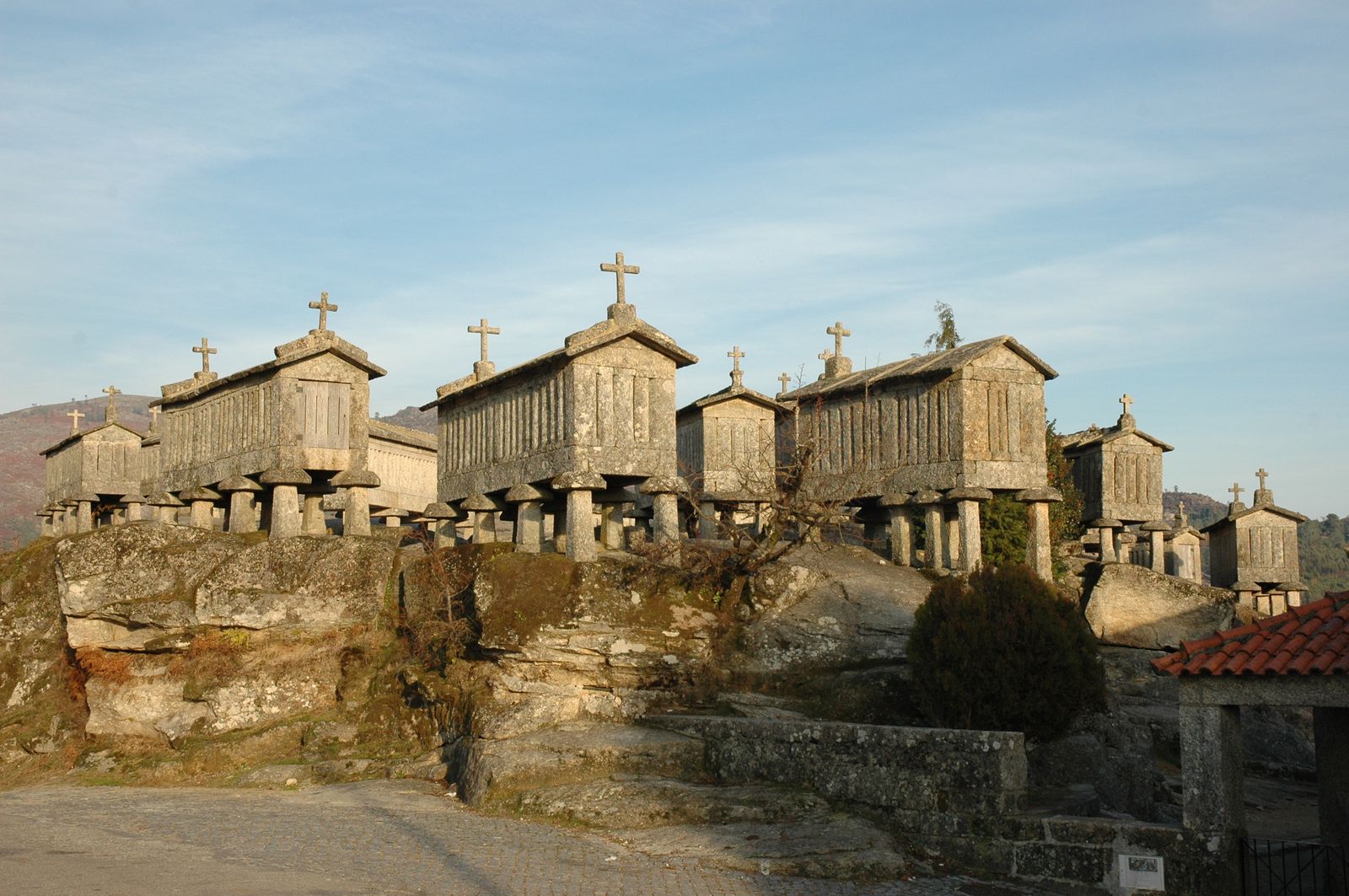
Drive into the park’s western valleys and you reach Soajo, a granite village built around a bare rock outcrop that the community has used as a communal threshing floor for centuries. Rising from that same rock stand around twenty espigueiros, stone granaries lifted on stilts and capped with a cross, built through the eighteenth and nineteenth centuries to keep corn dry and out of reach of rats. They look, from a distance, like a small stone village of their own. Twenty minutes further on, past the Alto-Lindoso dam, the village of Lindoso holds an even larger cluster, more than fifty espigueiros gathered beneath the ruins of a medieval castle. Neither village was built for visitors. Both still work more or less as they always have, which is precisely their appeal: this is one of the very few places in western Europe where you can watch a medieval agricultural landscape still quietly doing its job.
Wild horses and the healing waters
The park’s other residents are less visible but no less part of its character. Garrano ponies, a small, sturdy breed with roots going back to the Celtic era, still run semi-wild across the higher slopes; hunted nearly to extinction by the mid-twentieth century, their herds were deliberately rebuilt from the 1940s onward, and they now graze the undergrowth much as they have for millennia. The mountains are also among the last strongholds in Portugal for the Iberian wolf and for golden eagles, which is as good a measure as any of how little of this landscape has been tamed.
At the heart of it all sits Caldas do Gerês, a modest spa village on the banks of a mountain river, known to the Portuguese since at least the thirteenth century for the therapeutic quality of its waters, which the Romans are believed to have used long before that. The first proper bathhouse went up in the eighteenth century, under King João V, and the spa still operates today, tucked into the same wooded valley. A soak there, after a day on foot or on horseback, is as close as this corner of Portugal comes to indulgence, and it earns it.
How we weave it in
Peneda-Gerês sits an easy hour and a quarter from Porto along the A3 and the IC28, which makes it a natural extension to a northern circuit rather than a destination in itself. We most often fold it into a longer loop through the Minho: a night or two near Guimarães and Braga, a private driver comfortable with the park’s tight granite switchbacks, and a quinta or manor house base from which to explore Soajo, Lindoso and the wilder trails around Gerês itself. Travellers drawn to the historic stone villages further south tend to respond to this landscape for the same reason: nothing here has been restored for effect.
Late spring brings wildflowers and full rivers; September and October bring cooler walking weather and the first colour in the oak woods, and both are kinder than the height of August, when the park’s swimming holes and lakeside beaches, entirely justified attractions in their own right, draw crowds from across the north. Time a visit for a weekday, or for the shoulder seasons, and the silence returns almost immediately once you are a few hundred metres off the main road.
Our take
Peneda-Gerês will never compete with the Douro for polish or with Sintra for drama, and that is rather the point. It rewards travellers who want Portugal without an audience: granite villages that owe nothing to tourism, ponies that answer to no one, and a spa town that has been quietly doing its job since long before the word wellness existed. Paired with a couple of days in Guimarães and Braga, it turns a northern itinerary into something closer to a journey through the country’s actual memory, mountains included.
If a few unhurried days in Portugal’s wild north appeal, we will build them into your journey: the right base, the right driver for those mountain roads, the timing handled. Start a conversation, and let’s plan something quietly remarkable.