Guimarães and Braga: where Portugal began
Most first journeys to Portugal look south and west: Lisbon and Sintra, the Douro’s terraced river, a stretch of golden coast. All of it earns its reputation. But drive north of Porto, into the green folds of the Minho, and you reach two cities that most visitors sail past entirely, which is precisely why we love them. One is where the country was born. The other is older than the country itself. Together, Guimarães and Braga hold the deep memory of Portugal, and for travellers who have already met the postcard version, they are quietly among the most rewarding places we send them.
Guimarães, where a nation was born
Ask a Portuguese schoolchild where their country began, and the answer comes without hesitation: Guimarães. The claim is not sentiment. In the summer of 1128, on a field called São Mamede just outside the town, a young nobleman named Afonso Henriques defeated the forces loyal to his own mother and set in motion the process that would make him the first King of Portugal. Guimarães became, for a time, the fledgling kingdom’s first seat of power. A wall in the old town still carries the words every visitor photographs: Aqui nasceu Portugal, “Portugal was born here.”
The town wears its founding story lightly and beautifully. Above it stands the stern medieval Castle of Guimarães, its keep and towers little changed in nine centuries, and beside it the fifteenth-century Palace of the Dukes of Bragança, with its forest of brick chimneys and great banqueting halls. But the real pleasure is lower down, in the centro histórico itself, a warren of granite arcades, iron balconies and cobbled squares so intact that UNESCO inscribed it as World Heritage in 2001. Linger in the Largo da Oliveira, order a coffee under the arches, and watch a living town go about its day inside a medieval frame. When Guimarães was named a European Capital of Culture in 2012, it did so without losing an ounce of that ease.
Braga, older than the kingdom itself
Half an hour away lies Braga, and here the clock winds back further still. The Romans founded it around 16 BC as Bracara Augusta, naming it for the emperor, and it has been continuously lived in ever since, one of the oldest cities on the Iberian Peninsula. It became a centre of early Christianity remarkably early, and remains the spiritual heart of the Portuguese Church: its Sé, the cathedral begun in the eleventh century as the archdiocese was restored, is the oldest in Portugal, a layered treasury of Romanesque stone, Gothic chapels and gilded baroque.
An old saying divides the Portuguese cities by temperament: Braga prays, Porto works, Coimbra studies, Lisbon plays. There is truth in it. Braga is a city of churches and seminaries and Holy Week processions, but it is also, today, young and unexpectedly lively, full of students and good cafés. That contrast, of ancient devotion and modern buzz, is much of its charm.
The stairway that climbs to heaven
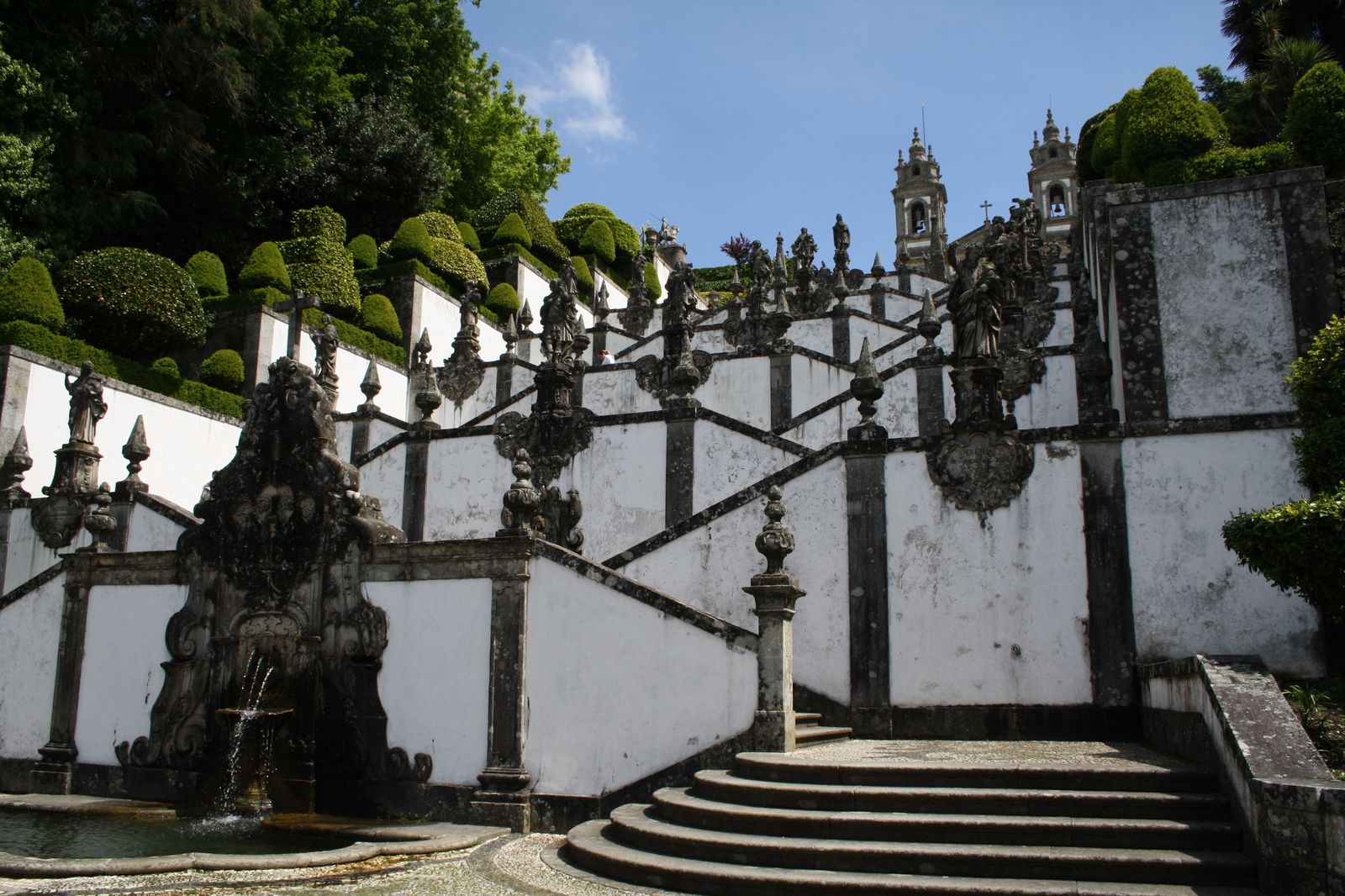
Braga’s greatest set piece sits a few kilometres out of town, on a wooded hill called Monte Espinho. Bom Jesus do Monte is a pilgrimage sanctuary, but you need not be a pilgrim to be moved by it. Its extraordinary baroque stairway zigzags up the hillside in a series of white-and-granite flights, each landing dressed with fountains, allegorical statues and small chapels, so that the climb becomes a slow, theatrical ascent past the Five Senses and the Three Virtues to the church at the summit. It was recognised as a UNESCO World Heritage Site in 2019, and photographs, including the one at the top of this page, rarely prepare you for its scale.
For those who would rather not climb, there is a small marvel of engineering: a funicular that has run since 1882, drawn up and down entirely by water, filling and emptying a tank to shift its own weight. It was the first of its kind on the Iberian Peninsula and is counted among the oldest still working anywhere in the world. Gliding up through the trees in a Victorian carriage, powered by nothing but gravity and water, is a quietly remarkable way to reach one of Portugal’s loveliest views.
When to go, and how we weave it in
The Minho is Portugal’s green corner for a reason: it catches the Atlantic weather, and the countryside is lush the year round. Late spring and early autumn bring the kindest light and the softest crowds; if your travels can align with Braga’s famous Holy Week, the city becomes something else again, though it draws the faithful in numbers. High summer is warm and busy but never overwhelming.
Both cities reward a slower hand. We most often fold them into a journey through the north: a base in Porto or a country manor house in the Minho, a private car and a driver who knows which chapel keeper holds the key, an unhurried loop that can take in the vineyards of the Douro Valley or the granite historic villages further inland. The Minho is also vinho verde country, the source of Portugal’s bright, faintly sparkling young wines, which we touch on in our piece on wine regions beyond the Douro. A day in each city, an overnight between them, and the north opens up.
Our take
Guimarães and Braga are not for the traveller counting monuments. They ask for a little curiosity and a slower pace, and they give back something rarer than a checklist: the sense of standing where a country actually began, in cities that never stopped being themselves. Pair them with Porto and the Douro and you have the makings of a northern journey that most visitors never think to take, which is, for those in the know, exactly the appeal.
If a few unhurried days in Portugal’s founding cities appeal, we will design them around you: the right base, the right guide, the timing handled. Start a conversation, and let’s plan something quietly remarkable.