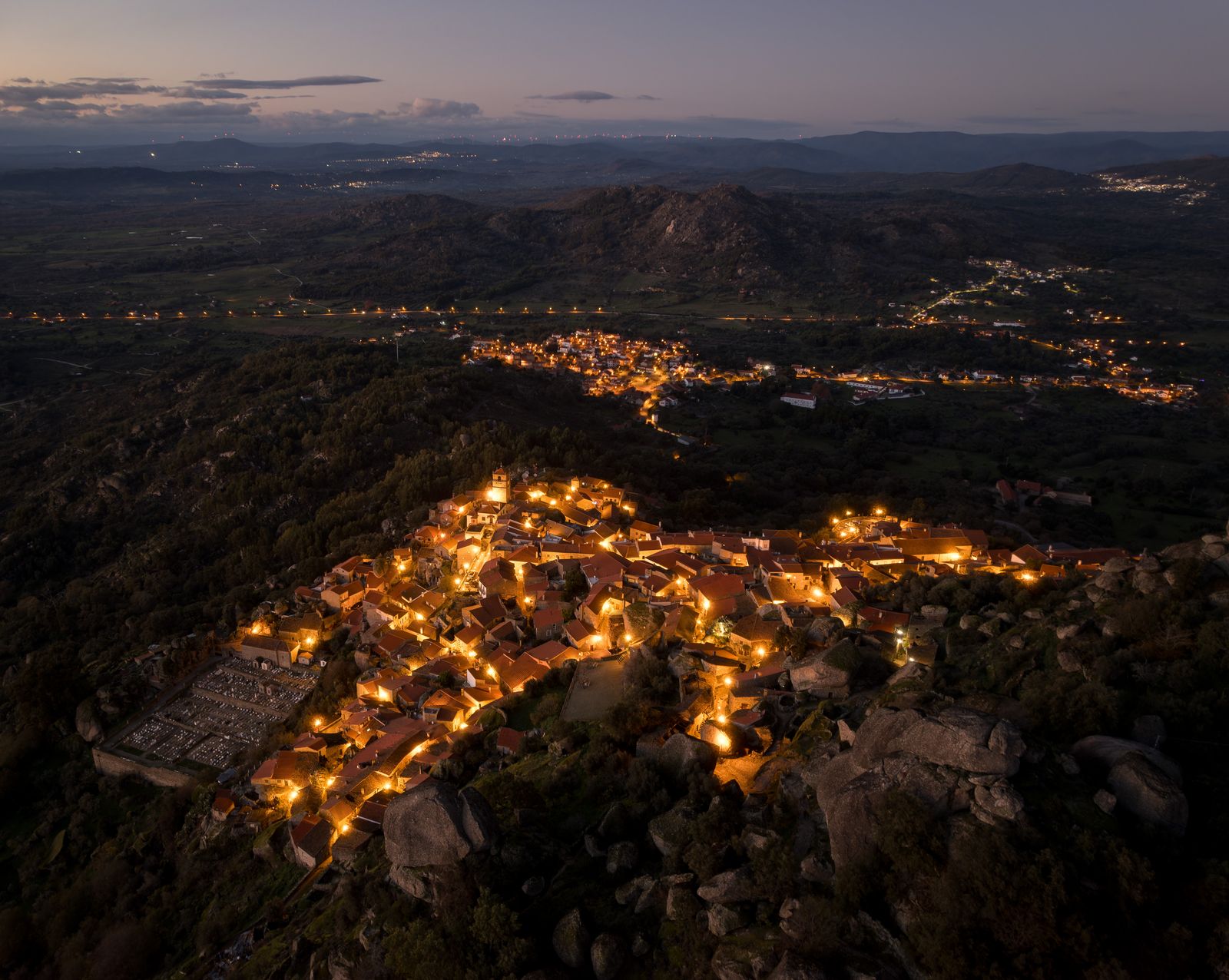
Portugal's historic villages
Most journeys to Portugal trace the coast: Lisbon, Sintra, the Douro, perhaps a few golden days in the south. All of it deserves the attention. But turn inland, toward the high country along the Spanish frontier, and you find a different Portugal entirely. Older, quieter, and built almost entirely of stone. This is the land of the aldeias históricas, the historic villages, and for travellers who have already met the famous Portugal, it is quietly one of the most rewarding places we send them.
A country carved from stone
There are twelve of them, gathered under a name and a careful restoration programme begun in the 1990s: a dozen granite and schist villages scattered across the Beira highlands, most within sight of the old border with Castile. For centuries this was frontier country, contested and fortified, and the villages still wear their history plainly: ramparts and ruined keeps, cobbled lanes worn smooth, churches and pillories and houses that seem to have grown out of the rock rather than been set upon it.
What they share is a feeling more than a checklist. Each sits high, each is small, and each is gloriously short of crowds. You can spend a morning in one and meet more storks than tour groups. For those in the know, that is precisely the appeal.
Monsanto, the village in the boulders
If you see only one, make it Monsanto. Clinging to a steep granite hill above the plain, it is a village built not beside its boulders but among them: houses wedged beneath rocks the size of cottages, walls running straight into bedrock, a single granite slab serving as somebody’s roof. The effect is uncanny and unforgettable.
In 1938 it was crowned “the most Portuguese village in Portugal,” and the silver rooster that was its prize still perches atop the old clock tower. More recently the village lent its primeval skyline to a celebrated television fantasy, which has brought a trickle of new admirers. Come early or stay late, climb the lane to the castle ruins at the top, and watch the light go long and golden over the plain toward Spain. It is, simply, one of the great views in Portugal.
Sortelha, Marialva and the walled silences
Other villages trade spectacle for atmosphere. Sortelha sits on a rocky escarpment at some 760 metres, its medieval wall encircling the old houses like a ring of stone; walk the ramparts at dusk and you may have the whole place to yourself. Marialva keeps a romantically ruined citadel above its living village, all fallen arches and wild fig. These are places to wander without a plan, to run a hand along eight-hundred-year-old granite, and to let the quiet do its work.
Belmonte, a navigator and a hidden faith
Belmonte rewards the curious twice over. Austere and handsome in its granite, it was the birthplace of Pedro Álvares Cabral, the navigator who reached Brazil in 1500. But its deeper story is quieter: Belmonte sheltered one of Europe’s most remarkable Jewish communities, families who kept their faith in secret across the long centuries of the Inquisition, passing it down within the home until it was safe to practise openly again. Today there is a synagogue and a thoughtful museum, and a thread of history you will find almost nowhere else.
Piódão, the schist exception
For something softer and stranger still, cross into the Serra do Açor to Piódão. Here the granite gives way to schist, and the village tumbles down its hillside in tiers of slate-dark houses, doors and shutters picked out in the same cornflower blue, an amphitheatre of stone that glows after rain. Alone among the twelve, Piódão has no castle to climb; it never needed one, hidden as it is in a fold of the mountains. The road in is long and winding. That is the point.
Almeida and the frontier forts
Further north, the frontier turns military. Almeida is the great set piece: seen from above, its walls form a perfect twelve-pointed star, a seventeenth-century fortress designed to hold the border against Spain. To walk its grassy ramparts and tunnelled gates is to step straight into the age of sieges. Nearby Castelo Rodrigo and Trancoso carry their own walls and legends, the latter laced with tales of a sixteenth-century cobbler-prophet whose verses are still quoted.
When to go, and how we weave it in
The interior runs to extremes: winters can be sharp and high-summer days fierce. Late spring brings wildflowers and soft green hills; autumn brings golden light, the grape and chestnut harvests, and the most flattering weather of the year. These are the windows we favour.
Practically, this is country best explored slowly and with your own wheels, a private car and a driver who knows which lane to take and which keeper holds the church key. The villages lie a comfortable drive apart, and reward an overnight or two rather than a dash. We most often fold them into a journey through the north, between the Douro Valley and the Serra da Estrela, where the granite high country also pours some of Portugal’s most characterful reds. (More on those in our piece on Portugal’s wine regions beyond the Douro.) Travellers drawn to hilltop drama and deep quiet often love the Alentejo for the same reasons.
Our take
The historic villages are not for the traveller in a hurry, or the one ticking sights. They ask you to slow down, to climb a little, to sit on a warm stone wall and watch the swifts. Do that, and they give back more than almost anywhere we know: the rare feeling of having found the real thing, the Portugal that Portuguese families keep for themselves. They are, in a word we use carefully, unhurried.
If a few unhurried days among the stone villages of the interior appeal, we will design them around you, the right base, the right guide, the timing handled. Start a conversation, and let’s plan something quietly remarkable.