The Azores beyond São Miguel
Almost every first journey to the Azores begins and ends on São Miguel. It is the largest island, it has the direct flights, and it delivers on everything the photographs promise: crater lakes, hot springs, hedgerows of hydrangea. Nobody leaves disappointed. But São Miguel is one island of nine, and the travellers who go on to the others tend to come back with a different sort of story. Not a bigger one. A quieter one.
The archipelago sits in three groups strung across roughly six hundred kilometres of open Atlantic: the eastern group of São Miguel and Santa Maria; the central group of Terceira, Graciosa, São Jorge, Pico and Faial; and, far to the west, Flores and Corvo. Each group has its own character, and the distances between them are part of the point. This is not an archipelago you tick off. It is one you choose from.
Pico: the mountain, and the wine that grows in lava
Pico announces itself from a long way off. The island is built around a single dormant volcano, Ponta do Pico, which at 2,351 metres is the highest point in all of Portugal and one of the great mountains of the Atlantic. On a clear morning it floats above the cloud line, visible from four neighbouring islands.
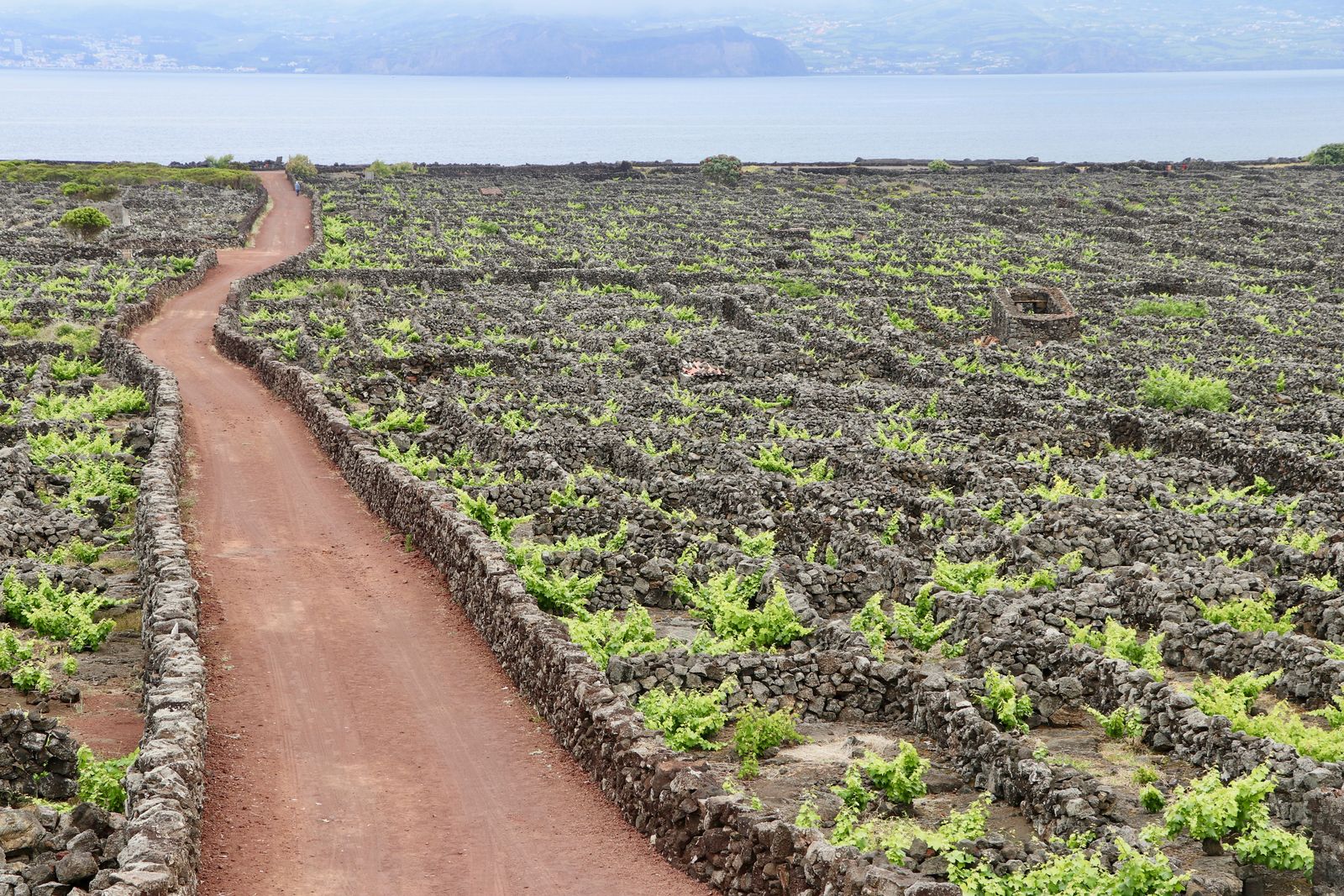
The mountain is the headline. The vineyards are the revelation. Along Pico’s western shore, generations of islanders built a landscape by hand: thousands of small enclosures of black lava stone, stacked without mortar, each one sheltering a few vines from the salt wind. The Portuguese call them currais, corrals, and from above they form a black lattice running down to the sea. UNESCO inscribed the Landscape of the Pico Island Vineyard Culture as World Heritage in 2004, and standing inside it, the achievement is hard to overstate: an agriculture invented from scratch on rock that should have grown nothing. The wines that come off it, mineral and saline, are among the most distinctive in the country, and a natural extension of our piece on wine regions beyond the Douro.
Faial: a harbour with a very long memory
A short channel crossing away lies Faial, and its capital, Horta, is one of the most quietly remarkable small ports in the Atlantic. For a century and a half, crews sailing between Europe and the Americas have put in here to rest and repair, and by tradition each one leaves a painted panel on the quay: a name, a date, a boat, a crest. The sea wall is now a mural several kilometres long, added to one crossing at a time. Sit with a coffee, look across the water at Pico rising out of the channel, and you understand why sailors talk about this harbour the way they do.
Faial also carries a scar that changed the island forever. On 27 September 1957, a volcano erupted from the sea off the island’s western tip, at Capelinhos. It burned intermittently for some thirteen months, buried farms and villages under ash, and drove a wave of emigration that reshaped Azorean families on both sides of the Atlantic. What remains is a lunar headland of grey ash and a half-swallowed lighthouse, with an interpretation centre built discreetly underground. It is the most sobering landscape in the archipelago, and the most extraordinary.
Terceira, São Jorge and the shape of a slower week
Terceira holds the archipelago’s other World Heritage listing. Angra do Heroísmo was for centuries an obligatory call on the routes between Europe, Africa and the Americas, and the wealth of that traffic shows: a grid of pastel façades, baroque churches, and two great harbour forts. UNESCO listed its historic centre in 1983. It is a proper town rather than a museum, and it knows how to enjoy itself.
São Jorge is the long, narrow one, a ridge of green cliffs falling straight into the sea. What makes it singular are the fajãs, small flat aprons of land formed at the cliff base by ancient landslides and lava flows, some reachable only on foot, several still farmed and lived in. The whole island became a UNESCO Biosphere Reserve in 2016. Its cheese, aged and firm and faintly sharp, is the one Portuguese people ask you to bring home.
Further west, Flores and Corvo are for travellers who genuinely want the edge of things. Flores, a Biosphere Reserve since 2009, is a green wall of waterfalls and crater lakes. Corvo has one village and something in the order of four hundred inhabitants, and at its northern end a vast collapsed crater, the Caldeirão, that you look into rather than at.
How it actually works
Inter-island travel is easier than the map suggests. SATA Air Açores flies between all nine islands, with hops ranging from about twenty minutes to an hour, and ferries link the central group in season, which is by far the loveliest way to move between Faial, Pico and São Jorge. The practical rule we work to: fly between island groups, sail within them, and give each island at least two nights. Three islands in ten days is a good rhythm. Five is a rush.
Weather is the honest caveat. These are mid-Atlantic islands and the sky changes by the hour, in any month. Late spring through early autumn offers the steadiest conditions, with June to September the most reliable for the Pico climb and for whale watching. We go into the seasons properly in our guide to the best time to visit the Azores. Build in slack, and treat a lost afternoon as part of the deal rather than a failure of planning.
Our take
If you have a week, São Miguel alone is a fine holiday. If you have ten days or more, splitting your time is what turns a holiday into something people talk about years later. We would pair Pico and Faial first, for the mountain, the vineyards and that harbour, and add São Jorge or Terceira depending on whether you want cliffs and cheese or cobblestones and company. Flores and Corvo we suggest only to travellers with time and patience, because the western group repays both and punishes neither hurry nor a tight connection.
None of it is complicated to arrange, but it does need someone watching the flight schedules, the ferry season and the weather windows on your behalf. That, more than anything, is the argument for planning it with a designer on the ground. If you are still weighing the archipelago against its Atlantic sibling, our comparison of Madeira and the Azores is the place to start.
If a slower crossing between three or four Azorean islands appeals, we will shape it around you: the right order, the right nights, the connections handled. Start a conversation, and let’s plan something quietly remarkable.