Stargazing in the Alentejo: the Alqueva Dark Sky Reserve and Monsaraz
Most travellers meet the Alentejo by daylight: cork oaks, whitewashed villages, long lunches that drift into the afternoon. Far fewer stay up late enough to discover its second life. In the far east of the region, where the Guadiana river meets the Spanish border, the land empties, the towns grow small and the sky after dark becomes something most of us have quietly forgotten exists. This is the Alqueva, and for those in the know it is one of the most remarkable places in Europe simply to look up.
A lake that changed the landscape
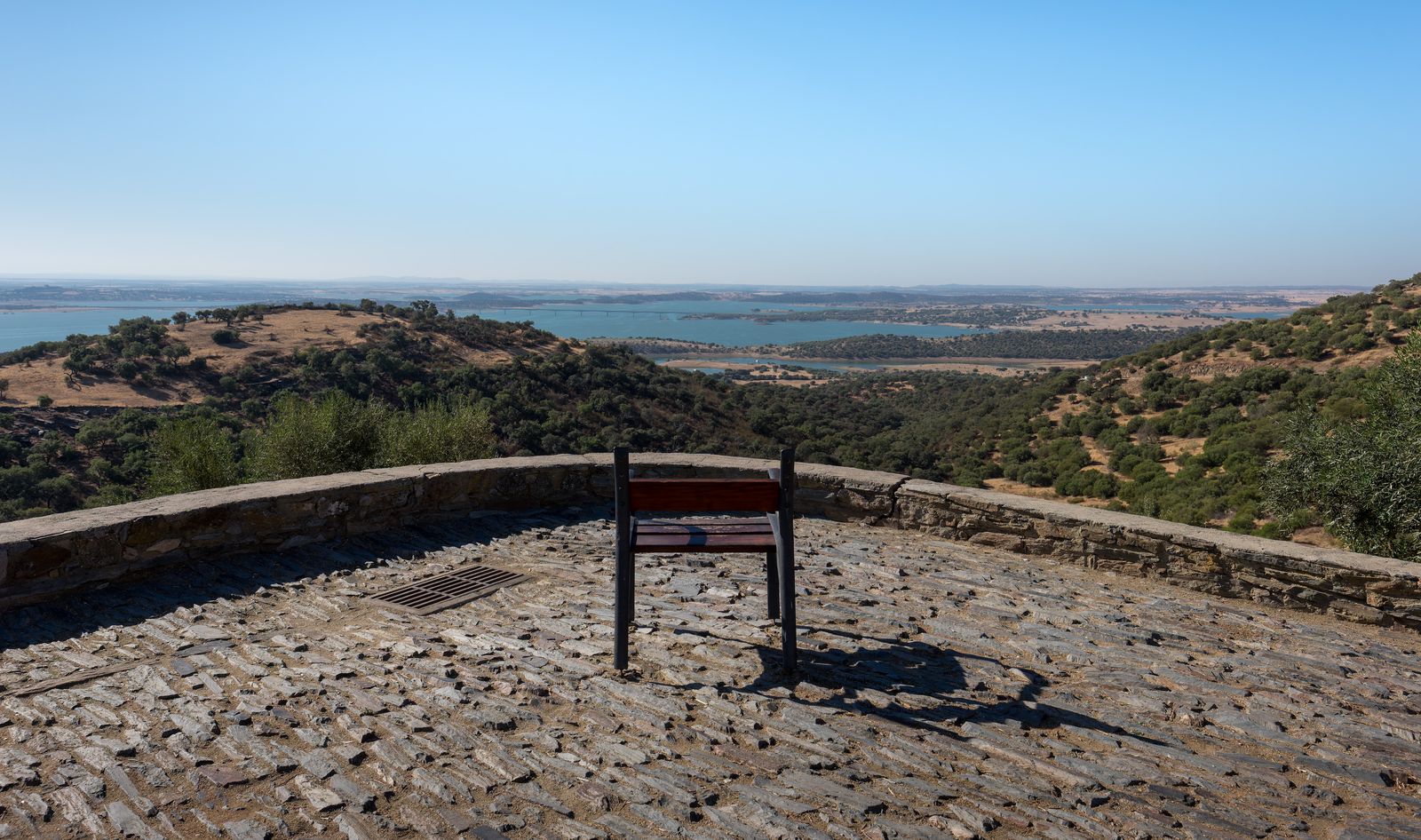
The story begins with water. In February 2002 the floodgates of the Alqueva dam closed on the Guadiana, and over the following years a reservoir slowly filled across the plains, reaching its planned level for the first time in 2010. The result covers roughly 250 square kilometres and is often described as the largest artificial lake in western Europe: a vast, branching body of blue threaded between low hills, with hundreds of small islands and a shoreline that seems to go on forever.
The lake brought irrigation, vineyards and a new rhythm to a dry region. It also came at a cost that is still worth understanding. The old village of Luz lay in the path of the rising water, and its people were moved to a new village built about two kilometres away, with its church reconstructed and its cemetery carefully relocated. The Museu da Luz, opened in 2003 on the edge of the new settlement, tells that story with photographs, film and objects saved from the original houses. It is a small, honest museum, and a visit gives the shimmering view across the water a depth that no postcard can.
Why the sky is so dark here
What makes the Alqueva special after sunset is, above all, what is missing. Population is sparse, towns are few and far apart, and there is little industry to wash the horizon in orange light. Add a dry inland climate and a high proportion of clear nights, and you have conditions that astronomers prize.
In December 2011 this territory became the world’s first certified Starlight Tourism Destination, recognised by the Starlight Foundation, an initiative backed by UNESCO, UN Tourism and the Instituto de Astrofísica de Canarias. The project, known as Dark Sky Alqueva, began with six Portuguese municipalities around the lake. It has since grown to ten on the Portuguese side, including Reguengos de Monsaraz, Mourão, Moura and Évora, and in 2018 it became the first cross-border Starlight destination when Spanish municipalities across the Guadiana joined.
In practice, this means local councils have committed to protecting the night: thoughtful public lighting, trained Dark Sky guides, and an official observatory at Cumeada, in the countryside below Monsaraz, where guided sessions take place on clear nights.
Monsaraz: a village above the water
If one place sums up the Alqueva, it is Monsaraz. The walled village sits on a steep hilltop above the lake, a single main street of whitewashed houses and schist paving running between two gates towards a castle at its far end. Its history is a frontier history. Monsaraz was taken from the Moors in 1167 by the adventurer Geraldo Sem Pavor, lost again, and retaken in 1232 under King Sancho II with the help of the Knights Templar, who were charged with guarding this border. The castle keep visible today belongs to the reconstruction of the early fourteenth century, when King Dinis strengthened the line of fortresses facing Castile.
By day, Monsaraz is lovely but busy with visitors who arrive, walk the street and leave. The village changes character entirely in the evening. Once the last cars have gone down the hill, the stone holds the day’s warmth, the castle walls turn gold and then grey, and the lake below fades into darkness. It is one of the few places where you can watch the sun set over one country and, a little later, see the stars rise over another. Monsaraz is one of the historic villages of Portugal we return to most often, and this is why.
What a night under the stars looks like
A guided session usually begins after dark with the naked eye: learning to find your way around the constellations, tracing the bright band of the Milky Way on summer nights, or picking out the great winter figures of Orion and Taurus. Then come the telescopes, turned towards the craters of the Moon, the rings of Saturn, the moons of Jupiter or a distant cluster of stars, depending on the season and what the sky allows. The guides are as much storytellers as scientists, and the best sessions feel less like a lesson than a conversation.
For travellers who prefer something more private, we arrange for a guide to meet you away from the observatory, at a quiet spot on the lakeshore or in the grounds of a country estate, with blankets, warm drinks and a sky entirely to yourselves. Families with curious children often find this the evening the whole trip is remembered by.
When to go and how we weave it in
The Alqueva can be enjoyed all year, but the seasons offer different skies. Summer brings the brightest view of the Milky Way and warm nights by the water. Autumn and winter bring longer, crisper nights, often beautifully clear, and the pleasure of stargazing wrapped up in a blanket before a late dinner by the fire. Whatever the month, the moon matters more than the calendar: we time a stargazing evening as close to the new moon as your dates allow.
Monsaraz sits roughly two hours by road from Lisbon and under an hour from Évora, which makes it a natural two-night stop on a longer journey through the region, such as our Alentejo and Algarve itinerary. Days can be spent in wine country around Reguengos, on the water in a small private boat, walking the streets of Évora or visiting the Museu da Luz, with the evenings kept free for the sky. If you are still deciding whether the region suits you, our honest answer to whether the Alentejo is worth visiting is a good place to start.
Our take
Stargazing can sound like a niche interest. It is not, and the Alqueva proves it. Very few of our travellers arrive thinking of themselves as amateur astronomers, yet almost all of them describe that night as a highlight of their time in Portugal. It asks nothing of you except a little patience and a willingness to stay up. The honest caveats: clouds are never fully predictable, the moon can wash out the faintest stars, and Monsaraz itself is busy on summer weekend afternoons. Plan around those, stay at least two nights so the weather has a second chance, and the reward is a sky that feels truly ancient, above a village that has watched over this border for eight centuries.
If a few unhurried nights beneath the Alentejo sky appeal, we will shape them around you: the right base, a private guide, the moon on your side. Start a conversation, and let’s plan something quietly remarkable.