Alcobaça, Batalha and Tomar: Portugal's monastic triangle
There is a stretch of central Portugal, an hour or so north of Lisbon, that almost every itinerary treats as road. Travellers cross it at speed on the way to Porto or the Douro, and they are not wrong to want what waits at the other end. But within a short drive of one another, in three unhurried country towns, stand three of the most extraordinary buildings in Europe. All three carry UNESCO World Heritage inscriptions. All three are usually half empty by four in the afternoon. And between them they hold, in stone, the founding story of the country.
We think of them as a triangle: Alcobaça, Batalha and Tomar.
Alcobaça: a love story that outlived everyone involved
Alcobaça came first. In 1153, Afonso Henriques, the warrior who had made himself Portugal’s first king, granted a great swathe of land to the Cistercians. What they built over the following century is enormous and, by design, almost entirely undecorated: a nave of pale stone running 106 metres, ribs of shadow overhead, and nothing at all to look at except proportion. It is the earliest Gothic architecture in the country and still among the most affecting, precisely because it refuses to charm you. The monks’ kitchen alone breaks the austerity, with a chimney the size of a small chapel and a channel of the river Alcoa diverted through the building so that fish could be lifted out of the water and cooked on the spot.
Then there are the tombs. In the transepts lie Pedro I and Inês de Castro, carved with a delicacy that belongs to a different building altogether. Pedro loved Inês; his father had her killed for reasons of state; when Pedro became king he had her body brought here and, by tradition, set the two tombs foot to foot so that on the day of resurrection each would rise facing the other. Every Portuguese child learns the story, and standing between them in that vast cold room it lands harder than the retelling suggests. UNESCO inscribed the monastery in 1989.
Batalha: a vow kept, and a room left open to the sky
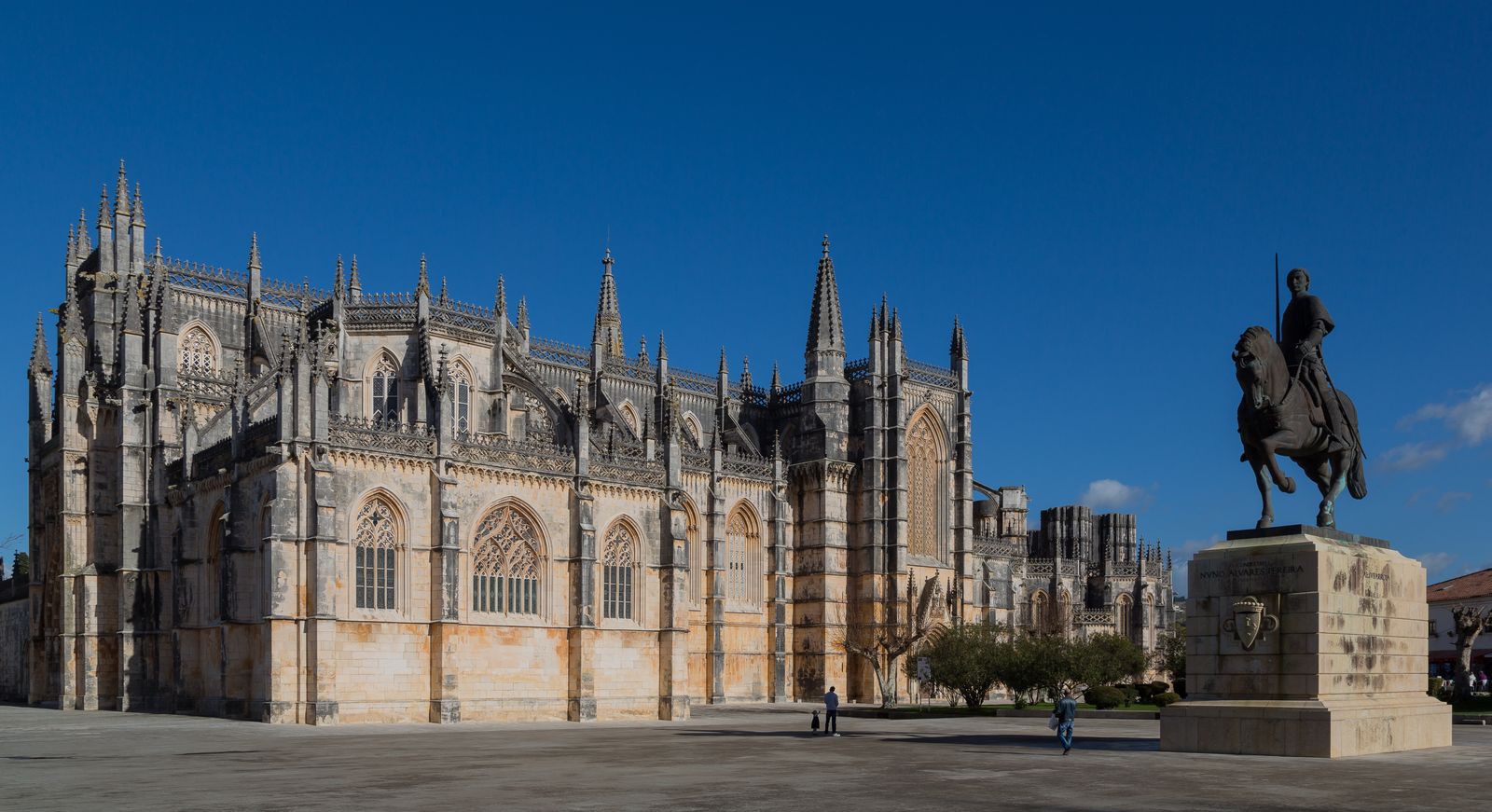
Twenty minutes up the road, the mood changes completely. On 14 August 1385, on a nearby field at Aljubarrota, a heavily outnumbered Portuguese army broke a Castilian invasion and secured the kingdom’s independence for good. On the eve of the battle, King João I had promised the Virgin a monastery if he won. Santa Maria da Vitória is that promise, kept at extravagant length: seven reigns of masons worked on it, and the limestone west front is a thicket of pinnacles, tracery and saints that seems to grow rather than stand.
Inside, the Founder’s Chapel holds João I and his English queen, Philippa of Lancaster, side by side beneath a star of stone, their carved hands joined. Along the wall lie their sons, among them Henry the Navigator, whose patronage sent Portuguese ships down the coast of Africa. The age of discoveries begins here, in a family vault, a generation before anyone reached India.
The building’s greatest room, though, was never finished. The Capelas Imperfeitas, commissioned by João’s son Duarte as his own resting place, were abandoned when funds and attention drifted to the sea. What remains is an octagon of soaring, roofless walls and a doorway carved into something closer to coral than masonry, standing open to the weather. Portuguese architecture has no finer accident. Batalha also keeps the country’s Tomb of the Unknown Soldiers, watched over without interruption since 1921. It joined the World Heritage list in 1983.
Tomar: the Templars, and a window that looks like the sea
An hour east, the story turns stranger. In 1160, Gualdim Pais, master of the Knights Templar in Portugal, raised a castle on a wooded hill above the river Nabão. At its heart the Templars built the Charola, a sixteen-sided rotunda modelled on the Holy Sepulchre in Jerusalem, painted and gilded inside until it glows like the inside of a reliquary. Knights are said to have heard mass here on horseback.
When the Templars were suppressed across Europe in the early fourteenth century, Portugal did something characteristically pragmatic: rather than surrender the order’s wealth to Rome, the crown had it reconstituted at home as the Order of Christ. Prince Henry was later its Grand Master, as was King Manuel I, and the order’s red cross sailed on ships bound for Brazil and the Indies. That inheritance is written all over the convent, which grew across five centuries into a complex of eight cloisters.
It reaches its peak in the chapter house window on the western wall, the most famous piece of Manueline carving in Portugal. Ropes, cork floats, coral, seaweed, an armillary sphere and knots of rigging climb the stone in a tangle that makes no architectural sense and perfect emotional sense. A nation had gone to sea, then came home and carved the sea into the side of a monastery. Tomar was inscribed in 1983, alongside Batalha.
How we would actually do it
The three sit within a rough triangle of about eighty kilometres, and the driving between them is easy and green. Alcobaça and Batalha are twenty minutes apart and pair naturally in a single morning; Tomar deserves a day of its own, or a long afternoon and a night in the town, which is small, handsome and pleasantly unbothered.
Our usual shape is two nights somewhere in the middle, breaking the journey north rather than making a separate excursion of it. That also puts the walled town of Óbidos and the fishing beaches of Nazaré within reach, so the days have air in them and not only vaulting. Late spring and September into October are the kindest months, with long light and cool interiors; midsummer is perfectly manageable, since the churches stay several degrees cooler than the street.
One practical note matters more here than almost anywhere. These are buildings whose meaning lives in the detail, and the detail is invisible without someone to point at it. The right art historian for a morning at Alcobaça and Batalha is the difference between three impressive churches and an afternoon you remember for years. That, and going late in the day, when the coaches have gone and the light comes in low along the nave.
Our take
If your journey is short and Lisbon is your first taste of Portugal, this is not where we would send you; our guide to how many days you need in Lisbon makes the case for staying put. But on a second visit, or on any itinerary travelling between Lisbon and the north, skipping the triangle is a real loss. Few places in Europe let you stand inside a country’s founding, its heartbreak and its ambition within the same day, and almost nowhere lets you do it in this much quiet. Travellers who love Portugal’s stone villages tend to love this for the same reason: the crowds simply have not arrived.
If a couple of unhurried days among Portugal’s monastic heartland appeal, we will build them into your journey north: the right guide, the right hour, the driving handled. Start a conversation, and let’s plan something quietly remarkable.