Cascais and the Estoril Coast: Lisbon by the sea, at a slower pace
Half an hour west of Lisbon, the river opens into the ocean and the light changes. The city’s terracotta gives way to palm-lined gardens, pastel villas and a long promenade above the water. This is the Estoril Coast, the stretch of shore from Estoril to Cascais and on round the cape to the wild beach at Guincho, and for more than a century it has been where Lisbon comes to breathe.
Most visitors see it for an afternoon. We often suggest the reverse: make the coast your base, and go into the city when you choose.
A coast with a past
Estoril’s grandeur is not an accident. In the late nineteenth century the Portuguese royal family began spending its summers in Cascais, and society followed. During the Second World War, neutral Portugal made the bay a crossroads: exiled royals settled into villas above the sea, refugees waited for passage to America, and spies of every allegiance watched each other across the casino tables. Ian Fleming passed through, and the Casino Estoril is often said to have planted the first seed of Casino Royale.
After the war, several of Europe’s exiled royal families stayed on. The coast kept something of that air: unhurried, well-dressed, a little nostalgic, and never in a rush to be fashionable.
Estoril and Cascais, side by side
Estoril is the formal one. Its casino faces the sea across a long garden, and the old hotels around it still carry the elegance of the years when kings took the winter here. It is a quiet, polished place to stay, a few steps from the beach and the station.
Cascais, next door, was a fishing town before it was a resort, and it still feels like a town. The old centre is a tangle of cobbled lanes and small squares, the fishermen still bring in their catch on the beach by the harbour, and the marina and the citadel sit at the end of the bay. In the evening it is livelier than Estoril, with good tables at every price.
Between the two runs the paredão, a seafront promenade of a little over three kilometres. Walk it early in the morning, when the joggers and the dog-walkers have it to themselves, or at sunset with an ice cream from Cascais.
Beyond the bay: Boca do Inferno, Guincho and Cabo da Roca
Just past Cascais, the shore turns rocky. At the Boca do Inferno, the “mouth of hell”, the Atlantic pours into a collapsed sea cave and booms back out; on a rough day the spray reaches the road. From there the coast road runs north to Guincho, a great open beach backed by dunes and the Sintra hills, all wind and surf and long horizons.
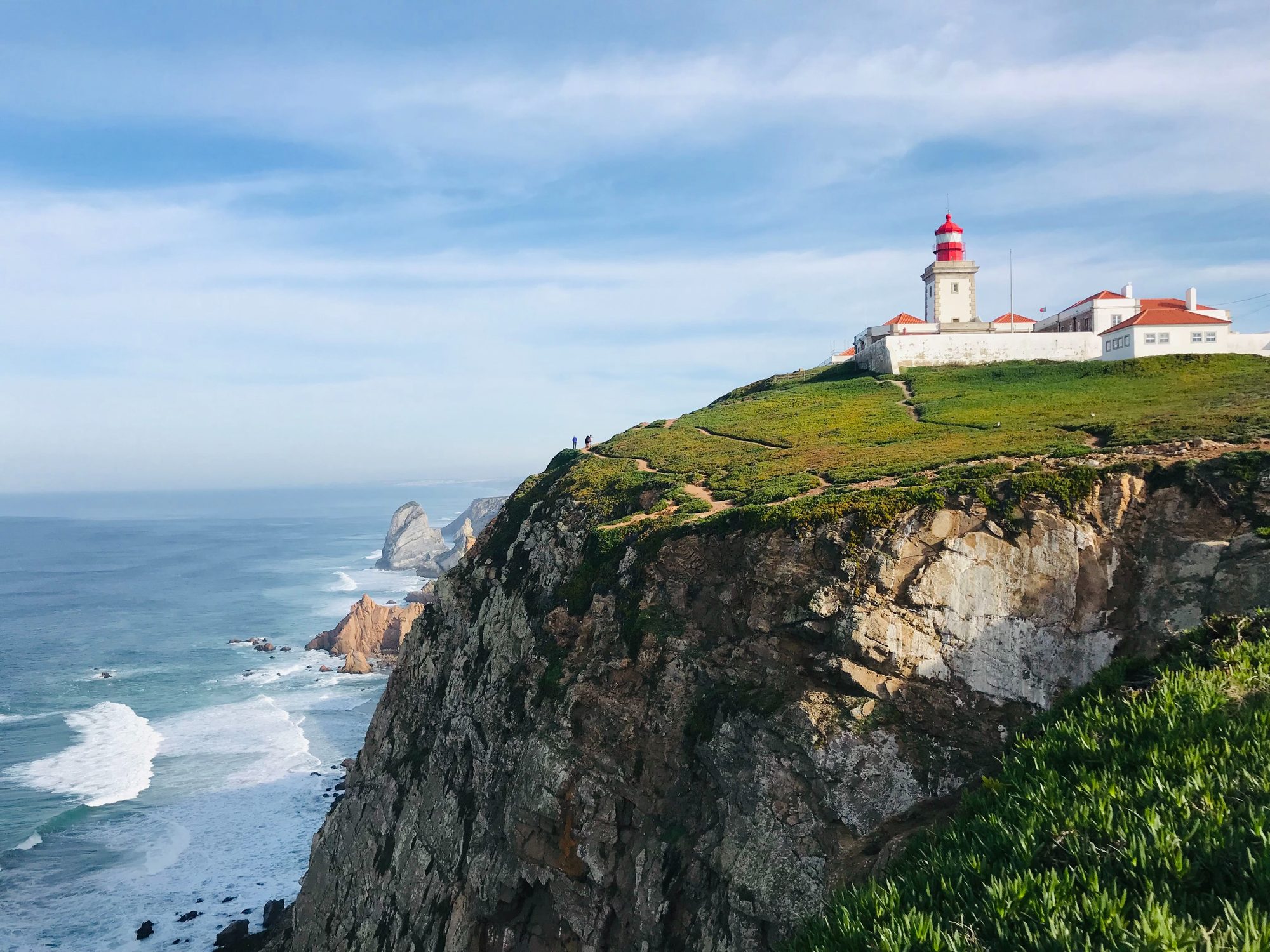
A little further on, Cabo da Roca is the westernmost point of mainland Europe, a cliff top with a lighthouse and nothing beyond it but the ocean. Go late in the afternoon, when the coach groups have gone and the light turns gold.
And because this is the Atlantic, the coast eats well. A lunch of grilled fish or barnacles above the waves at Guincho or the Boca do Inferno is one of the great simple pleasures of Portugal; our guide to the best seafood restaurants in and around Lisbon has the tables we book.
Why make it your base
The Estoril Coast sits at the centre of a triangle. Lisbon is half an hour by car, or forty minutes on the coastal train from Cais do Sodré. Sintra, with its palaces and forested hills, is about the same distance inland. The beaches are on your doorstep.
That makes it a beautiful place to stay for a longer holiday, or for the second half of one: a few days in the city first, then the coast. You spend the day in Lisbon or Sintra, and come back in the evening to a terrace above the sea rather than a street full of tuk-tuks. Families find it easier, too: more space, gentler beaches, and no hills to climb with a pushchair.
When we design a stay here, we place you in the right corner of the bay for the way you travel: a palace-era hotel in Estoril, a quiet house above Cascais, or somewhere with a view straight out over Guincho. We arrange a driver for the days in the city and keep the evenings free for the coast.
A day on the coast, if you have only one
If your days are counted, the coast still makes a perfect day out from Lisbon: the coast road through Estoril and Cascais, the Boca do Inferno, Cabo da Roca and Guincho, with lunch by the sea and time for your feet in the sand. Our private day trip to Cascais, Estoril and Cabo da Roca does exactly that, with your own guide and driver. If you would rather combine the coast with the palaces, the Sintra, Cascais and Estoril day trip does both.
For a longer stay, tell us how you like to travel and we will shape a tailor-made holiday in Portugal around a few days by the sea. Start a conversation.
Questions we are asked about the Estoril Coast
Is it better to stay in Lisbon or Cascais?
It depends on the shape of your trip. For a first visit of two or three nights, stay in Lisbon and visit the coast for a day. For a longer stay, or if you love the sea and a slower rhythm, Cascais or Estoril make a beautiful base: Lisbon is half an hour away, Sintra about the same, and you come home each evening to the sound of the Atlantic.
How far is Cascais from Lisbon?
Around 30 kilometres. By car it takes roughly half an hour outside rush hour. The coastal train from Cais do Sodré runs along the river and the sea and takes about forty minutes to Cascais, stopping at Estoril on the way.
What is the difference between Estoril and Cascais?
They sit side by side on the same bay. Estoril is the grander of the two, with its casino, gardens and old hotels from the days when Europe’s exiled royalty wintered here. Cascais is the former fishing town next door, livelier, with a marina, an old centre of cobbled lanes and the road out to Guincho and Cabo da Roca.
Can you swim on the Estoril Coast?
Yes. The sheltered beaches of the bay, from Carcavelos to Cascais, are the gentlest, best from June to September. Guincho, beyond Cascais, is wild open Atlantic, wonderful to look at and loved by surfers and kitesurfers, but often too rough for an easy swim.