Arrábida and Azeitão: the quiet south of Lisbon, one unhurried day
Cross the Tagus and the country changes its mind. The terracotta city falls away, the road climbs into scrub and pine, and then the hills open and there it is: a sea so clear and green-blue it looks borrowed from somewhere warmer, lying at the foot of a sierra that seems to belong to another latitude.
This is the Arrábida, the part of Lisbon’s hinterland that those in the know keep for themselves. It is under an hour from the city, and yet most visitors never go. We think it is one of the quietly remarkable days in the whole of Portugal.
Where Lisbon runs out of road
The Serra da Arrábida is a low coastal ridge on the Setúbal Peninsula, protected as a natural park since 1976. What makes it special is how many climates it holds at once. The northern slopes lean towards the damp green of the Atlantic, while the southern slopes, facing the water, are warm and dry and thick with Mediterranean scrub. In spring the air smells of wild herbs; in autumn the light turns soft and gold.
The best way to meet it is slowly, by road, stopping where the view asks you to. The narrow coast road along the ridge is one of the loveliest short drives within reach of Lisbon, with the sea appearing and disappearing between the pines.
A convent among the trees
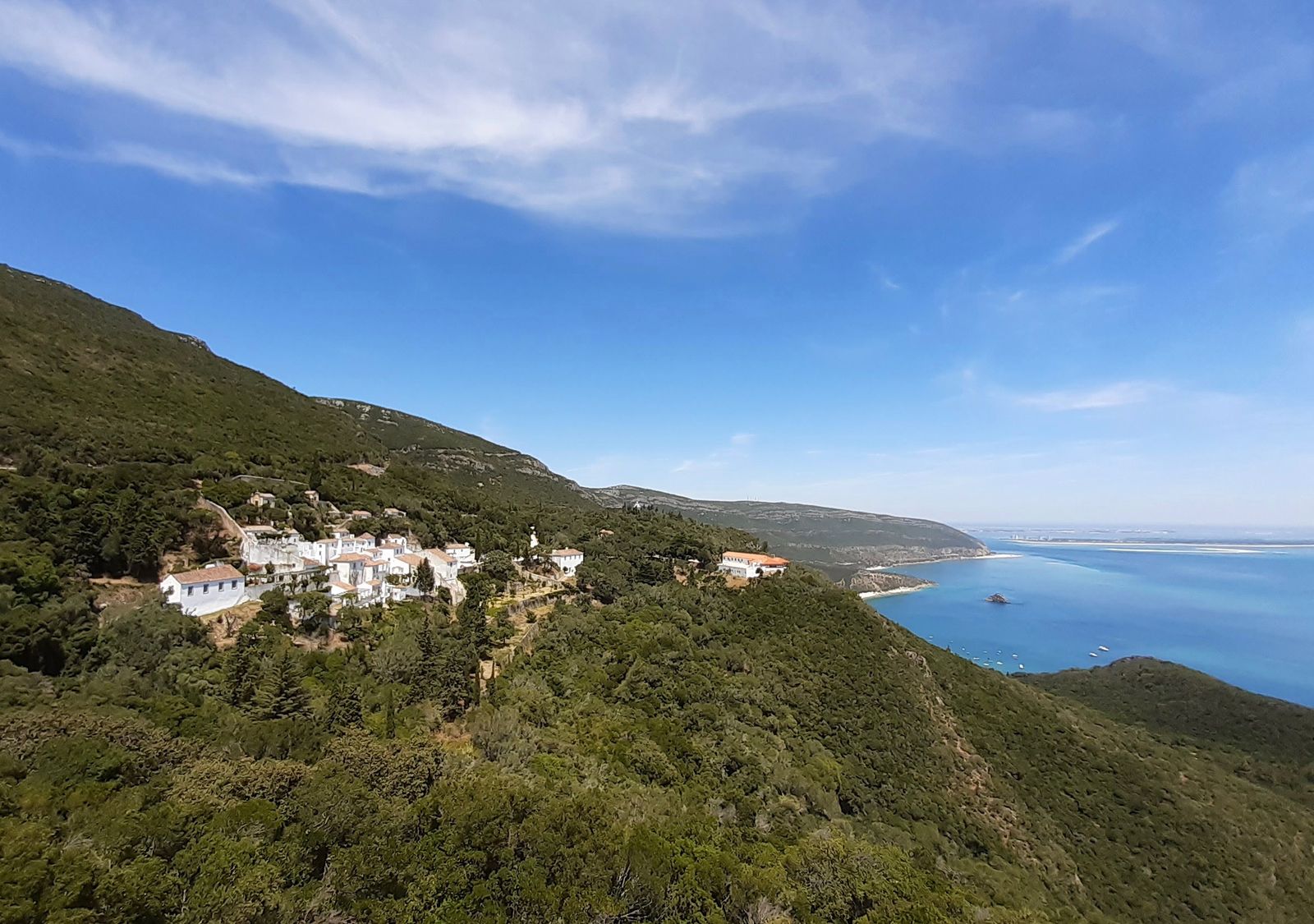
Halfway down the southern slope, half hidden by vegetation, the Convento da Arrábida looks out over the water. Franciscan friars settled here in the 1540s, first in simple cells carved into the rock, and the community lived on for almost three centuries, until the religious orders were expelled from Portugal in 1834.
The setting is the point. Terraces step down the hillside, the buildings seem to grow out of the stone, and the silence is the kind you can hear. Visits are by advance booking, in small groups, so this is not somewhere to turn up on a whim. It is something we arrange for you, and it is worth the planning.
The coves below
Further down, the road drops to Portinho da Arrábida, a small, sheltered cove of pale sand and calm water in colours you would expect in the Mediterranean, not an hour from a European capital. Swim if the season allows, or simply sit with your feet in the shallows and your back to the green sierra.
It is also where timing matters. In high summer, and on warm weekends in particular, the coves fill up. Spring, early summer and the golden weeks of September and October are kinder, and a weekday is always better than a Saturday.
Azeitão: cheese, wine and old cellars
Inland from the coast lies Azeitão, a village of whitewashed houses, manor gardens and long-established wine cellars, and the heart of one of Portugal’s quietest food traditions.
The Queijo de Azeitão is made from raw sheep’s milk and set with a vegetable rennet taken from the cardoon thistle, a method that gives it its gentle, slightly bitter edge. It has held protected designation of origin status since 1996, and it can only be made in the municipalities of Palmela, Sesimbra and Setúbal. It is soft and spreadable, rich and a little wild, and it is the sort of thing you remember long after you have forgotten the name of the road.
The wine to taste beside it is Moscatel de Setúbal, a fortified wine made from the Moscatel de Setúbal and Moscatel Roxo grapes. The region was demarcated in 1907, and the wine has the honeyed, amber depth of something that has been left alone to age. A tasting in an old cellar, with a piece of that cheese and nowhere else to be, is one of the great unhurried hours of a Portuguese holiday. We go deeper into the region’s other wines in our guide to Portugal’s wine regions beyond the Douro.
Sesimbra and Cabo Espichel
To the west, Sesimbra is still a working fishing town, with boats on the beach and a harbour that sets the rhythm of the day. Beyond it, the land runs out at Cabo Espichel, a windswept headland with a lonely eighteenth-century sanctuary, built to receive pilgrims, standing at the edge of the cliffs.
Nearby, in the rock below the cliffs, are the footprints of sauropod dinosaurs from the Jurassic. Local legend long read them as the tracks of a giant mule that once carried the Virgin Mary, and the name of the site, Pedra da Mua, still remembers that story. The footprints are hard to read from above, so go with someone who knows where to stand.
If your trip also takes in the sea, the Sado estuary just beyond Setúbal is home to a resident pod of bottlenose dolphins; our guide to dolphins and whales near Lisbon explains how to meet them well.
Our take
The Arrábida is a day for people who enjoy the journey itself. If you have only two or three days in Lisbon, spend them in the city and in Sintra first; the south is the day you add when you have already seen the postcard.
It also rewards care. The best of it, the convent, the cellar and the right cove at the right hour, depends on booking and timing, and on a driver who is not watching the clock. Done in a rush, it is pleasant. Done slowly, it is one of the things people talk about afterwards.
It works particularly well as the first day of a longer journey: the Arrábida in the morning, a long lunch, and then on towards the Alentejo by evening.
Planning your day
Our private Arrábida wine tour from Lisbon takes in the park, a tasting at one of Portugal’s oldest wineries, Sesimbra and Cabo Espichel, with your own guide and driver. For something longer, or to fit the south into a wider journey, we design every day around you: a tailor-made holiday in Portugal, with the convent visit, the cellar and the quiet cove all arranged in advance.