Portugal by Car: Five Self-Drive Routes Worth Taking
Portugal is made for the road. It is a small country with huge variety: a wild Atlantic coast, cork forests, fortress villages on the Spanish border, terraced valleys, and almost no traffic once you leave the cities. In a single day you can drive from sea cliffs to hilltop castles, with a long lunch in between.
This guide sets out five self-drive routes we design again and again, what each one feels like behind the wheel, and who it suits. If you are still deciding how many days to give the trip, start with our guide to Portugal in 7 and 10 days.
First, where not to drive
Lisbon and Porto are for walking, with the occasional taxi or sunset sail on the river. A car in either city is a burden: hills, narrow streets and parking. In almost every road trip we design, the car starts when the cities end, and is returned before they begin again. It is the single best piece of advice we can give.
Route one: the coast, from the Costa Vicentina to the west Algarve
The wild end of the Algarve is not the resort end. Think long empty beaches, cliff-top paths, white villages on the Atlantic side, and a coast that is best explored from one comfortable base rather than a different bed every night. From there the driving is short and rewarding, to the cliffs and fortress at Sagres, to Lagos and the sandstone headlands, to the castle at Silves, and to the caves of Benagil from the water. A good first road trip, and a good second one too. See the Algarve.
Route two: the Alentejo and its border towns
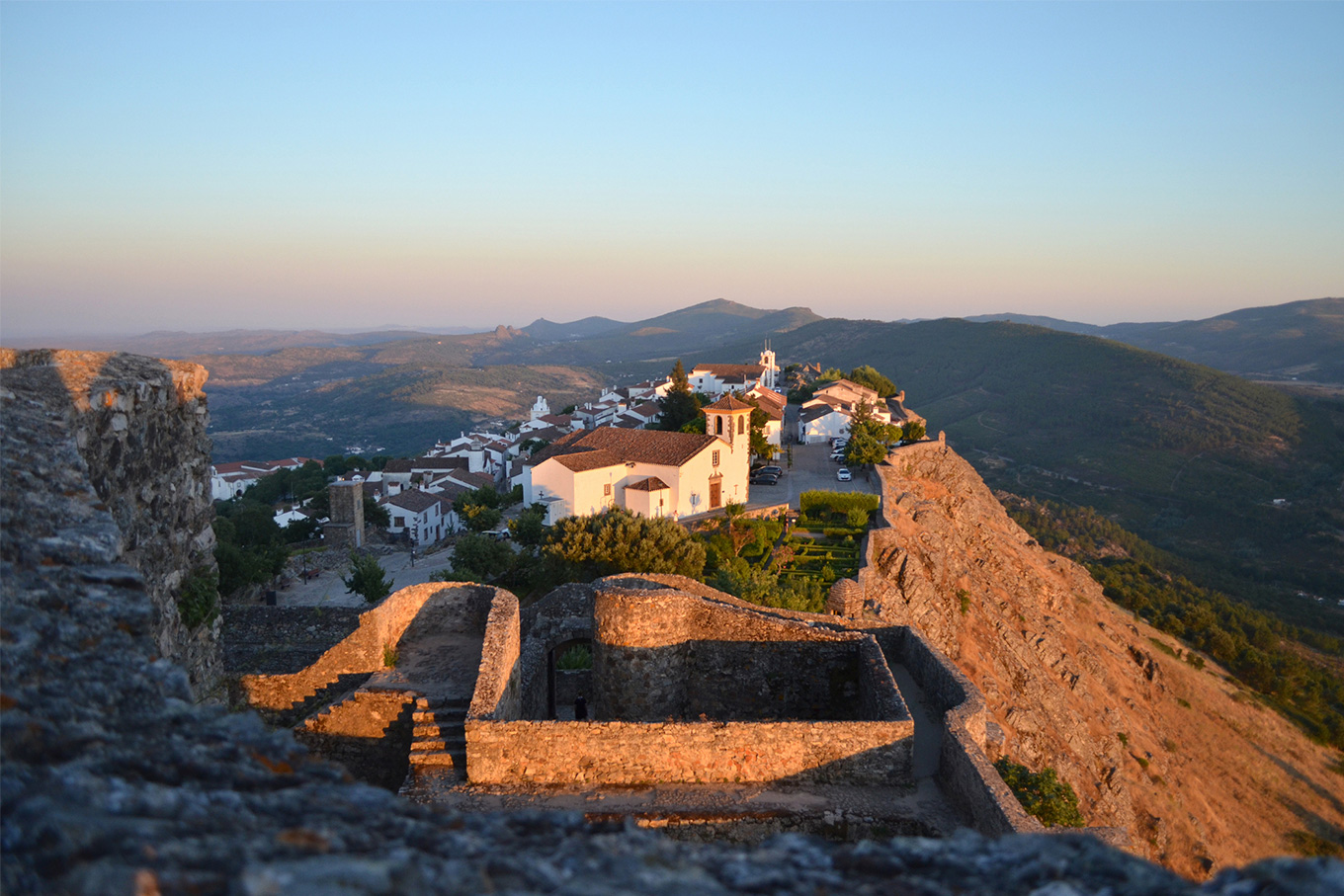
This is the slow route. Wide plains of cork oak and olive, white villages, and a chain of fortress towns facing Spain: Marvão on its granite crag, Elvas with its star-shaped walls, Estremoz in marble, Évora, Monsaraz above the great Alqueva lake, and the river town of Mértola. The roads are quiet, and the days are built around a single leisurely lunch. It pairs naturally with a finish on the coast, as in our self-drive Alentejo & the Algarve in 10 days, or with the Douro. See the Alentejo.
Route three: the Douro and the green north
The most scenic road in the country follows the river. Terraced vineyards fall to the water, the villages hang above it, and the riverside road is slower than the map suggests, which is part of the point. Add the old cities of Guimarães and Braga, the valleys of the Alto Minho, and the walkways in the Arouca hills, and you have a week that rarely repeats itself. It suits travellers who love food, wine and walking. See the Douro Valley and Porto & the Douro in 7 days.
Route four: the villages of the interior
The road less taken. The Beira Interior is a region of walled hill villages that most visitors never see, with castles and granite lanes at Trancoso, Marialva, Almeida and Castelo Rodrigo, the boar sculptures of Castelo Mendo, Sortelha at sunset, boulder-built Monsanto, and the schist village of Piódão with its blue doors. Nights in the hills are cool, even when the coast is warm, and the pace is slow. It suits repeat visitors and travellers who like history, and we often combine it with a few days in Coimbra. We design this one on request.
Route five: the islands
Madeira and São Miguel are the best self-drive destinations in the country, because the island is the route. One base, a rental car, and a different landscape every day: levada walks and mountain peaks in Madeira, crater lakes, hot springs and whales in the Azores. Both are covered in our week-long self-drive journeys, Madeira in 7 days and São Miguel in 7 days.
What makes a road trip work
- One long drive, never two in a row. The day you cross from one region to the next needs a clear start and few stops. Leave the next morning free.
- Fewer bases than you think. Two or three hotels give you better days than five.
- Time to stop. The best moments on these routes are rarely on the itinerary: a village market, a viewpoint, a long lunch.
- A guide in your pocket. Our MLH roadbook gives you the day-by-day route, the stops worth making and the ones to skip, so you can drive without a screen telling you what to do.
How we plan it
Self-drive with us means a rental car, hotels we have chosen for each stop and your own MLH roadbook, with a single point of contact in Portugal if anything changes. If you would rather watch the landscape than the road, the same route works with a driver and, where it adds something, a guide. The chauffeured version is a private tour of Portugal in the plainest sense, and the self-drive version is private in spirit: no coach, no group, and the pace is yours. Many travellers mix the two.
Questions we’re often asked
Is Portugal good for a road trip? It is one of the best in Europe. The scenery changes every day and traffic is light outside the cities, so you spend your time looking at the landscape and not the clock.
How many days do I need for a road trip in Portugal? A week is enough for one region, such as the Alentejo and the coast, or the Douro and the north. Ten days lets you combine two. We would not try to fit the whole country into one trip.
Is it better to self-drive or to have a driver? Both work. Self-drive suits travellers who like their independence and comfortable country roads, and comes with our roadbook. A driver and guide suit those who prefer to relax, taste wine freely and leave the parking to someone else. We can arrange either, or mix them.
Can I pick up the car in one city and drop it in another? Yes, and we often do, for example starting in Lisbon and finishing in Porto. It saves you retracing your route and keeps the car out of the cities.
What is the best time of year for a Portugal road trip? Spring and early autumn are the most reliable: warm, green or golden and calm. The interior is fierce in high summer and cool at night in autumn. Our month-by-month guide covers every region.
Is a road trip good for a first visit to Portugal? Yes, if you pair a few days in Lisbon or Porto on foot with a rental car for the countryside. That is the shape of most of our first-time itineraries.
Tell us your dates and who is travelling, and we will come back with a first route. If you would like to talk it through, we are happy to arrange a call. Start a conversation.