A first look at Madeira
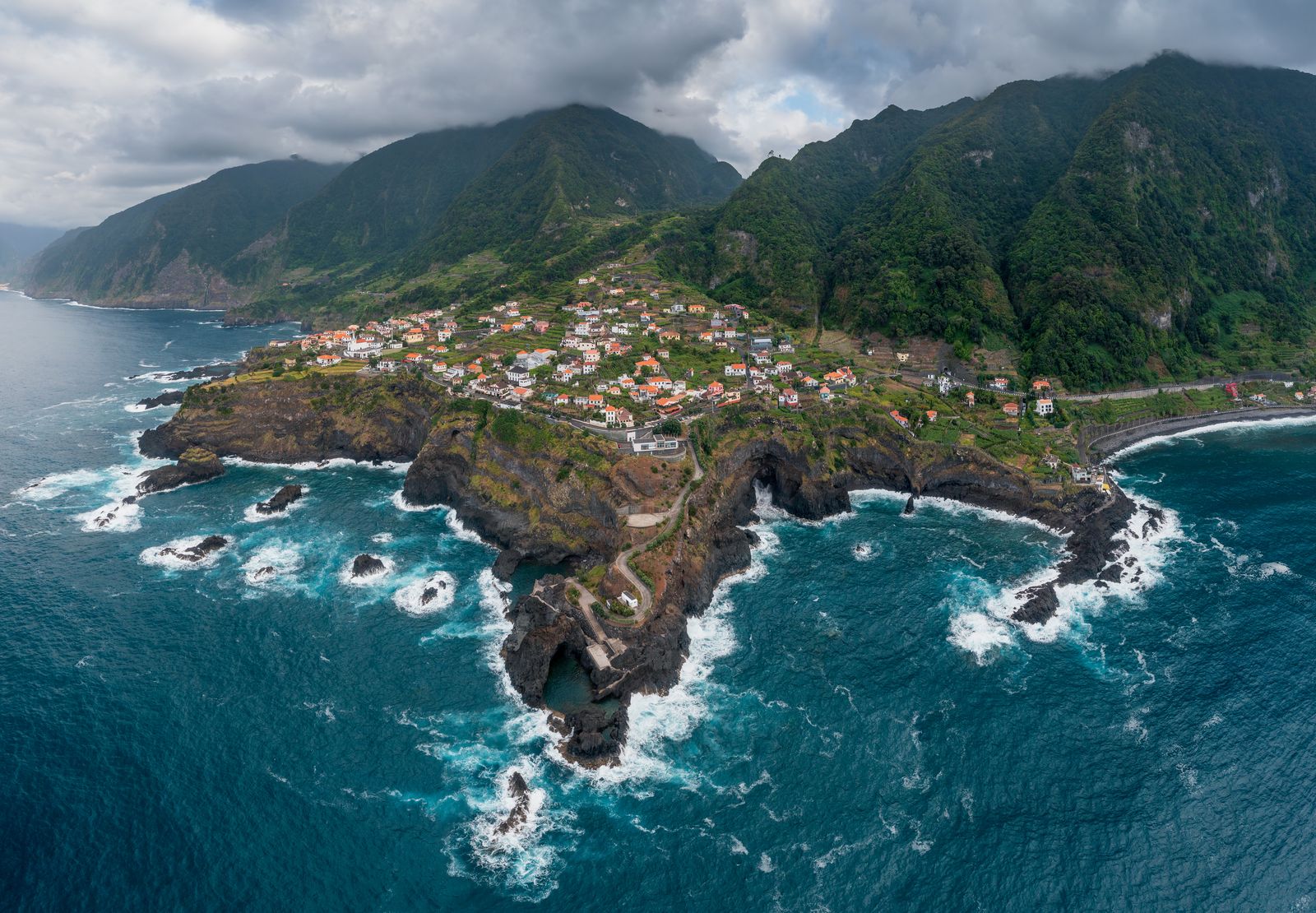
Some six hundred kilometres off the coast of mainland Portugal, out where the Atlantic runs deep and blue, a single green mountain rises straight from the sea. This is Madeira, and it does not much resemble the rest of the country. There are no long beaches here, no flat horizons, no whitewashed plains. Instead there is verticality, wet green forest, cloud caught on the peaks, and a mildness in the air that has earned the island one of its fond old names: the island of eternal spring. For travellers who think they know Portugal, it is quietly one of the most surprising places we send them.
An island that grows straight up
Madeira is small, barely more than fifty kilometres end to end, and yet it climbs to 1,861 metres at Pico Ruivo, its highest summit and the third highest in all of Portugal. That single fact shapes everything. Roads corkscrew through tunnels and up ravines; villages cling to terraces that look, from below, almost impossible to farm. Drive from the sunlit south coast to the wild north in an hour and the weather changes with the altitude, from subtropical warmth to cool mountain mist.
The reward for all this drama is scenery of a kind you find almost nowhere else in Europe. On a clear morning, the walk between Pico do Arieiro and Pico Ruivo runs along a knife-edge of volcanic rock, often above a sea of cloud, with the whole island falling away on either side. It is one of the great high walks of the Atlantic, and for those in the know, reason enough to come.
The levadas, or walking on water
Madeira’s most quietly remarkable feature is also its most practical. Because rain falls generously on the green north but the sunnier south stays dry, islanders spent centuries solving the same problem: how to move water across a near-vertical landscape. Their answer was the levadas, narrow irrigation channels cut by hand into the mountainsides, begun in the fifteenth century to feed the early sugar-cane fields and extended, generation after generation, into a network that now runs to well over two thousand kilometres.
Alongside almost every channel runs a maintenance path, and those paths have become one of the finest walking networks anywhere. To follow a levada is to walk gently, almost on the level, deep into country you could otherwise never reach: through tunnels and tree-ferns, past waterfalls, along contours where the water still murmurs beside your feet exactly as it has for five hundred years. Some are broad and easy; a few are not for those uneasy with heights. We choose the route to the walker.
The forest that time forgot
Climb into the island’s damp interior and you enter something genuinely ancient. Madeira holds the largest surviving expanse of laurisilva, the laurel forest that once cloaked much of southern Europe before the ice ages pared it back to a few Atlantic islands. Here it covers around a fifth of the island, and in 1999 it was inscribed as a UNESCO World Heritage Site.
The most beguiling corner is Fanal, a high plateau where squat, twisted laurel trees, some many centuries old, stand in wet meadows that fill, most afternoons, with rolling mist. Walk in early and you may have it entirely to yourself: no sound but dripping leaves, the trees looming and fading in the fog like something from a older world. It is the kind of place that stays with people long after the trip is over.
Funchal, and the pleasure of arriving slowly
The island’s capital, Funchal, curls around a south-facing bay in a warm amphitheatre of hills. It is a handsome, unhurried city of cobbled streets and flower markets, of a historic quarter painted by local artists, and of tropical gardens that spill down the slopes above the harbour, thick with plants gathered from every latitude the old navigators reached.
Above the city sits the leafy parish of Monte, and the descent from it comes with a flourish found nowhere else. Since the mid-nineteenth century, when the carros de cesto were a genuine means of getting downhill quickly, visitors have ridden the two-kilometre run to Funchal in a wicker toboggan, steered by two carreiros in white cotton and straw hats who brake with the soles of their boots. It is half heritage, half theatre, and entirely Madeiran.
A glass of history
No introduction to the island is complete without its wine. Madeira is one of the world’s great fortified wines, an accident of history perfected over time: casks once carried across the tropics returned unexpectedly improved by the heat and motion of the voyage, and the island learned to recreate that gentle cooking on land. The result keeps almost indefinitely and ranges from bright and dry to deep and honeyed. A tasting in an old Funchal lodge, cellars stacked with barrels going back decades, is among the most civilised hours the island offers.
When to go
This is the island’s other gift: there is no bad season. The subtropical climate keeps Funchal mild the year round, and even winter rarely turns cold at sea level, though the peaks can be another matter. Spring brings flowers and the island’s exuberant festival of them; summer is warm and busy; autumn is settled and quiet, our own favourite for walking. Whenever you come, pack for two climates, the coast and the heights, because on Madeira you will often meet both in a single day.
Our take
Madeira asks a little more of a traveller than a beach ever will, and gives far more in return. It rewards those who walk, who climb a little, who linger over a view or a glass rather than rush to the next thing. Pair it with a few days on the mainland, or set it beside its greener Atlantic cousins, the Azores, and you have a Portugal most visitors never glimpse. It is, in the end, an island for the unhurried, and all the better for it.
If a green island rising out of the Atlantic sounds like your kind of escape, we will shape it around you: the right walks, the right base, the timing handled with care. Start a conversation, and let’s plan something quietly remarkable.